Because sometimes the most fascinating person you’ll ever get to know is yourself.
Let me ask you something, bestie.
How well do you REALLY know yourself?
And no, I’m not talking about knowing your favorite color, your coffee order, or which celebrity you’d embarrass yourself over if you ever met them in person. (Although those are important pieces of information, obviously.)
I’m talking about the deeper stuff.
Do you know why you think the way you do? Why certain people drain your social battery faster than an iPhone on 2%? Why you react to certain situations differently from everyone else? Or why you sometimes feel like a walking contradiction?
Personally, I have a pretty good sense of who I am. I’m introverted, imaginative, creative, emotional, independent, and occasionally an Olympic-level overthinker.
But here’s the funny thing: the more I learn about myself, the more I realize there’s still so much I don’t know.
And naturally, I want answers.
I want to understand my motivations, my fears, my strengths, my weaknesses, my relationships, and why my brain insists on analyzing a conversation that ended three business days ago.
That’s probably the INFJ in me.
If you’re wondering what the hell an INFJ is, don’t worry. We’re getting there.
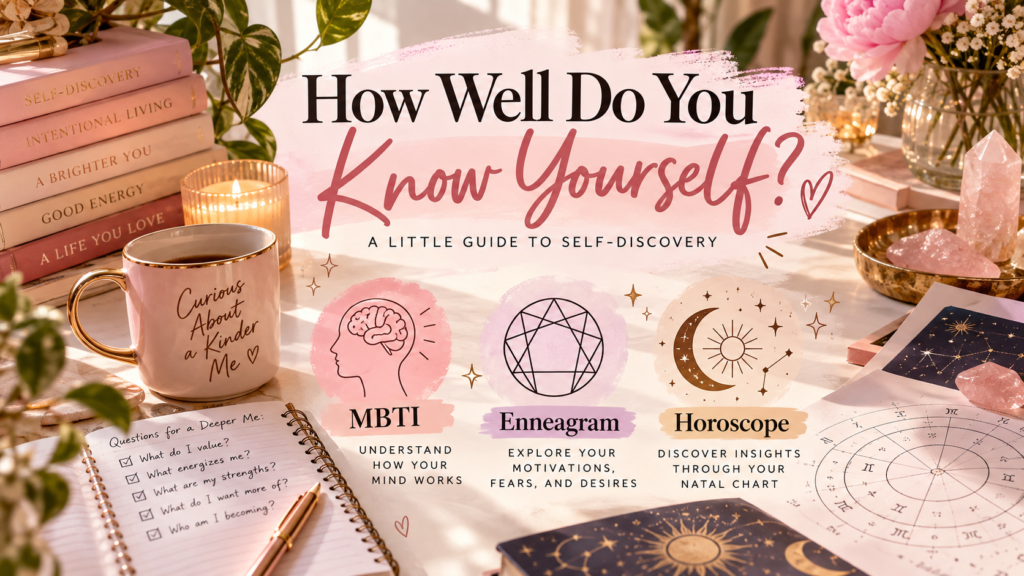
Over the years, I’ve found three interesting systems that have helped me reflect on who I am: the Myers-Briggs Type Indicator (MBTI), the Enneagram, and astrology, particularly natal charts.
And before anyone rolls their eyes at that last one, hear me out.
I’m not suggesting that the stars, a personality quiz, or a four-letter label have all the answers to your existence.
What I am suggesting is that sometimes learning about yourself requires asking questions you’ve never thought to ask.
And these systems can be interesting places to start.
First, a Little Disclaimer Before We Start Psychoanalyzing Ourselves
I love a good personality assessment, but let’s establish something important.
You are a human being, not a personality type.
MBTI and Enneagram assessments are self-reflection tools, not medical or psychological diagnoses. Their scientific support is limited, and online results can be influenced by your mood, personal experiences, and how honestly you answer the questions.
Astrology is different again. Although your birth chart can be calculated from astronomical positions, there is no reliable scientific evidence that zodiac placements determine your personality or future. I enjoy exploring astrology as a symbolic and personal-interest practice, not as scientific fact.
These tools should never be used to diagnose yourself, excuse harmful behavior, stereotype others, or decide what you are capable of achieving.
For example, being an introvert doesn’t mean you’re incapable of leadership. Being emotional doesn’t mean you’re weak. And having a particular Enneagram type doesn’t mean you’re destined to struggle with the same fears forever.
Also, please don’t take a personality test while pretending to be the most perfect version of yourself.
We all want to believe we’re mature, emotionally intelligent, organized, and completely unbothered.
Meanwhile, some of us are still mentally arguing with someone from 2019.
Answer as the person you actually are, not the person you’re trying to become.
Now that we’ve gotten the responsible adult disclaimer out of the way, let’s get into the fun stuff.
1. MBTI: Understanding How Your Mind Works
Let’s start with one of my personal favorites: the Myers-Briggs Type Indicator, commonly known as MBTI.
MBTI is a personality framework that organizes people into 16 types based on four pairs of preferences.
Those preferences are:
- Extraversion (E) vs. Introversion (I): Whether you tend to direct your energy toward the outer world or your inner world.
- Sensing (S) vs. Intuition (N): Whether you prefer focusing on concrete details or patterns and possibilities.
- Thinking (T) vs. Feeling (F): Whether you tend to prioritize impersonal logic or personal values when making decisions.
- Judging (J) vs. Perceiving (P): Whether you generally prefer structure and decisions or flexibility and open-ended options.
Combine those letters, and you get one of 16 personality types.
For example, someone might be an ENFP, ISTJ, INTP, or, in my case, an INFJ.
My Personality Type: INFJ, aka The Advocate
INFJ stands for Introverted, Intuitive, Feeling, and Judging.
It’s commonly described as one of the rarer personality types, although exact rarity rankings vary depending on the population and assessment.
INFJs are often portrayed as thoughtful, idealistic, empathetic, imaginative, and deeply interested in understanding people.
And when I first started reading those descriptions?
Girl.
It felt like somebody had been reading my diary.
I enjoy meaningful conversations, but I also love being alone. I have a vivid imagination, but I’m also a planner. I’m sensitive to other people’s feelings, yet I value my independence.
And my brain? Oh, she’s busy.
Sometimes I can turn a simple situation into a full psychological documentary, complete with character development, possible motives, and an unnecessarily dramatic conclusion.
Here’s a Real-Life Example
Imagine you’re invited to a party.
An extroverted person might look forward to meeting people, socializing, and enjoying the energy of the room.
An introverted person might enjoy the party too, but eventually feel the need to recharge alone.
Neither experience is better or worse.
In my case, I might enjoy myself, have some meaningful conversations, observe the social dynamics, and then disappear into my peaceful little world afterward.
Being introverted doesn’t automatically mean you’re shy, antisocial, or dislike people.
It often has more to do with how you prefer to engage with the world and restore your energy.
What Can MBTI Teach You?
I think MBTI is especially interesting when considering work environments, communication preferences, and relationships.
For example, understanding that I prefer independence, creativity, and meaningful work helps me recognize why certain environments appeal to me more than others.
I don’t necessarily need a job where I’m the center of attention.
Give me some autonomy, a comfortable environment, interesting work, and a paycheck that respects my bills.
Thank you very much.
Of course, MBTI cannot scientifically determine which career you’ll succeed in. Your abilities, experience, interests, and circumstances matter much more than four letters.
Think of the results as conversation starters, not instructions for living.
Take a free MBTI-style assessment:
16Personalities — Free Personality Test
Note: 16Personalities is a free, MBTI-inspired assessment, not the official MBTI instrument. It also includes an Assertive/Turbulent dimension that isn’t part of traditional MBTI.
2. The Enneagram: Understanding Your Motivations, Fears, and Desires
Now, if MBTI gets you thinking about how you tend to operate, the Enneagram invites you to examine why you do the things you do.
And this is where things can get a little personal.
The Enneagram is a personality framework consisting of nine types, each associated with particular motivations, desires, and fears.
For example:
Type
Common description
1
The Reformer — principled and improvement-oriented
2
The Helper — caring and relationship-oriented
3
The Achiever — ambitious and success-oriented
4
The Individualist — expressive and identity-oriented
5
The Investigator — curious and knowledge-oriented
6
The Loyalist — cautious and security-oriented
7
The Enthusiast — adventurous and possibility-oriented
8
The Challenger — assertive and autonomy-oriented
9
The Peacemaker — accommodating and harmony-oriented
Unlike simply describing someone’s behavior, the Enneagram encourages you to explore the motivation underneath it.
My Enneagram: Type 4, The Individualist
Recently, I’ve been learning more about my Enneagram type, which is Type 4.
And honestly? It explains why individuality and self-expression resonate with me so strongly.
In Enneagram theory, Type 4 is associated with authenticity, creativity, emotional depth, and a desire to develop a meaningful sense of identity.
One of its commonly described fears is feeling insignificant or lacking a distinct identity.
That part got my attention.
I’ve always valued being myself, even if that means having interests, opinions, or personal preferences that don’t fit neatly into society’s expectations.
It’s one of the reasons I created Pink She Wrote.
I wanted a personal space where I could express my thoughts, femininity, imagination, and occasionally unpopular opinions without feeling pressured to fit into someone else’s definition of who I should be.
What Are Enneagram Wings?
Here’s where things get even more interesting.
In traditional Enneagram theory, your core type can be influenced by one of the numbers directly next to it. These are called wings.
As a Type 4, my potential wings are:
4w3 — The Individualist with a Three Wing
Often associated with creativity, ambition, achievement, self-expression, and a desire to have one’s work recognized.
4w5 — The Individualist with a Five Wing
Often associated with introspection, imagination, independence, curiosity, and a desire for deeper understanding.
I can relate to qualities of both.
One side of me wants to create something beautiful, meaningful, and successful.
The other side wants to hide in my own little world, research random subjects, write my thoughts, and be left alone in peace.
It’s giving creative ambition meets mysterious woman in a library.
Here’s a Real-Life Example
Imagine two people starting blogs.
The first person wants to create a successful platform, build recognition, and share her unique creative vision.
The second person wants a private creative outlet where she can explore her thoughts and express herself without outside expectations.
Both might identify with Type 4, but their different motivations could be discussed through the lens of their wings.
Of course, actual human motivations are more complicated than that. You can want both things without fitting perfectly into either category.
That’s why I suggest reading about the types rather than trusting the first test result you receive.
What Can the Enneagram Teach You?
The Enneagram can encourage reflection on questions such as:
- What am I most afraid of losing?
- Why do I seek approval, independence, security, or recognition?
- How do I respond when I feel misunderstood?
- Which emotional patterns keep showing up in my life?
- Am I making decisions because I genuinely want something, or because I’m afraid of something?
Those are powerful questions, regardless of whether the Enneagram accurately categorizes you.
Take a free Enneagram assessment:
Eclectic Energies — Free Enneagram Tests
The website offers assessments that can suggest your core type and wing. Treat the results as starting points rather than definitive conclusions.
3. Astrology: Exploring Your Natal Chart Beyond Your Zodiac Sign
Okay, my astrology girlies, it’s your turn.
Most people are familiar with their zodiac sign.
You know the usual conversations.
“Oh, you’re a Gemini? That explains everything.”
“You’re a Scorpio? I should’ve known.”
Or my personal favorite: people blaming an entire relationship disaster on Mercury retrograde.
Listen, sometimes the man was just a walking red flag. We don’t need to involve Mercury.
Anyway!
When people talk about their horoscope, they’re usually referring to their Sun sign.
But astrology has a much larger system called a natal chart, also known as a birth chart.
A natal chart is a symbolic map of the positions of celestial bodies at the time and place of your birth.
In astrology, those positions are traditionally interpreted as representing different aspects of personality, emotions, relationships, and life experiences.
Again, these interpretations aren’t scientifically established. But if you enjoy symbolism, mythology, and self-reflection, they can be fascinating to explore.
Your Big Three: Sun, Moon, and Rising Signs
Astrology enthusiasts often begin by exploring what is called the Big Three.
Sun Sign — Your Core Identity
In astrology, your Sun sign symbolizes your sense of self, individuality, and outward expression.
I’m a Cancer Sun.
Cancer is traditionally associated with emotional sensitivity, intuition, protectiveness, and an appreciation for comfort and security.
Do I relate to some of those qualities? Absolutely.
Does being born in late June scientifically explain my personality? No.
But it’s interesting to consider how those themes connect with my experiences.
Moon Sign — Your Emotional World
Your Moon sign is traditionally interpreted as representing your emotional needs, instinctive reactions, and what brings you comfort.
For example, someone with a Taurus Moon might be described in astrology as seeking stability, consistency, and a peaceful environment.
Someone with a Pisces Moon might be characterized as imaginative, sensitive, or emotionally receptive.
These are astrological interpretations, not proven personality traits.
Rising Sign — How You Present Yourself
Your rising sign, also called your Ascendant, is traditionally associated with first impressions, outward presentation, and how you approach unfamiliar situations.
Mine is Virgo Rising.
Virgo Rising is commonly described as observant, detail-oriented, thoughtful, and practical.
Now, considering how much I love planning, researching, analyzing, and organizing?
I can certainly appreciate the symbolism.
Here’s a Real-Life Example
Imagine two people who are both Cancer Suns.
One has Leo Rising and another has Virgo Rising.
According to traditional astrological interpretations, the first might be portrayed as expressive and attention-grabbing, while the second might be portrayed as reserved and observant.
But in real life, their behavior would be shaped by countless factors, including temperament, upbringing, culture, and personal experiences.
That’s why I prefer treating astrology as an interesting lens for reflection rather than a universal explanation for human behavior.
How Do You Find Your Natal Chart?
To calculate one, you’ll typically need your birth date, birthplace, and ideally your exact birth time.
Your birth time is especially important for calculating your rising sign and astrological houses.
If you don’t know your birth time, you can still explore portions of a chart, but some placements may be uncertain.
Create a free natal chart:
The basic chart is free, though some additional interpretations and services may cost money.
And one little privacy reminder: your complete birth details are personal information, so review a website’s privacy practices before entering them.
4. What Happens When You Put All Three Together?
Now, this is my favorite part.
Rather than treating these three systems as independent instructions for who I should be, I like comparing the themes that resonate with me.
Here’s how I might describe myself using all three:
My MBTI: INFJ
I value introspection, meaningful connections, imagination, and independence.
My Enneagram: Type 4
I strongly value authenticity, individuality, creativity, and self-expression.
My Astrological Placements: Cancer Sun and Virgo Rising
I can relate to the symbolic themes of sensitivity, observation, and practicality.
Do you notice a pattern?
Across all three descriptions, I keep encountering themes such as introspection, creativity, emotional awareness, and individuality.
Now, that doesn’t mean the systems have independently proven those qualities about me.
Some descriptions are broad enough that many people could relate to them, a phenomenon psychologists call the Barnum effect.
But comparing the descriptions encourages me to think about what actually reflects my lived experiences.
And that’s what I find valuable.
I get to ask myself:
Am I really like this? When does this describe me? When doesn’t it? And is this who I naturally am, or who I’ve learned to be?
That’s where genuine self-discovery begins.
5. Don’t Just Take the Tests. Actually Get to Know Yourself.
Here’s something I want you to remember.
Taking a personality test is easy. Understanding yourself takes effort.
You can complete every assessment on the internet and still struggle to recognize your own boundaries, emotional triggers, motivations, and habits.
So once you’ve explored your results, I encourage you to go a little deeper.
Try These Five Self-Discovery Exercises
1. Keep a self-reflection journal.
Write about your moods, reactions, decisions, and daily experiences.
For example, instead of simply writing, “Work was stressful today,” explore why it was stressful.
Was it a lack of control? Too much stimulation? Unclear expectations? A conflict with your values?
Understanding the cause matters more than giving yourself a label.
2. Pay attention to what energizes and drains you.
Think about the environments and activities where you feel most comfortable.
Maybe you enjoy socializing but need quiet evenings afterward.
Maybe you’re creative but prefer structure.
Maybe you love helping people but dislike being constantly available to everyone.
These observations can help you make choices that suit your needs.
3. Identify your core values.
Ask yourself what genuinely matters to you.
Is it freedom? Stability? Creativity? Recognition? Peace? Financial security? Authenticity?
And here’s the important part: are your everyday decisions aligned with those values?
4. Ask trusted people how they experience you.
Sometimes others notice patterns we overlook.
You might think you’re quiet and reserved, while your closest friends see you as hilarious, expressive, and passionate.
Both perspectives can be true.
You don’t need to accept every opinion someone has about you, but thoughtful feedback can reveal interesting blind spots.
5. Give yourself permission to change.
Please don’t make your personality type your entire identity.
If you’re introverted, you’re still allowed to become more outgoing.
If you’re cautious, you’re still allowed to take risks.
If you identify as sensitive, you’re still allowed to develop stronger emotional boundaries.
The purpose of understanding yourself isn’t to remain the same forever.
It’s to recognize who you are today while allowing yourself to grow.
Final Thoughts: You Are More Than a Four-Letter Type, a Number, or a Zodiac Sign
I think one of the most beautiful things about being human is that we are constantly discovering different parts of ourselves.
The person I was five years ago isn’t exactly the person I am today.
My interests have evolved. My priorities have shifted. I’ve developed new boundaries, questioned old beliefs, and learned to appreciate certain qualities about myself that I didn’t always understand.
And I’m sure I’ll continue changing.
That’s why I enjoy learning about personality frameworks.
Not because I need someone or something to tell me who I am.
But because I’m curious about the woman I’m becoming.
For me, MBTI has provided language for some of my preferences. The Enneagram has inspired questions about my motivations. Astrology has offered symbolism that I sometimes find interesting.
But none of these systems knows me better than I know myself.
And they certainly don’t get to decide my future.
So, bestie, take the tests. Read the descriptions. Question your results. Reflect on your experiences. Discover your strengths and acknowledge your weaknesses.
Just remember that a personality label should never become a personality prison.
You are allowed to be complex.
You are allowed to be contradictory.
And you are absolutely allowed to become someone your old personality-test results never predicted.
Because discovering yourself isn’t about finding the perfect label.
It’s about becoming more intentional about who you are, what you value, and the life you want to create.
And personally?
I think that’s a lifelong adventure worth taking.
Stay curious. Stay evolving. Stay unapologetic.
— Noelle 💗
Let’s Talk, Besties!
Have you ever taken an MBTI or Enneagram test, or explored your natal chart?
Did the results describe you perfectly, completely miss the mark, or make you question everything you thought you knew about yourself?
Drop your MBTI type, Enneagram number, or Big Three in the comments! I’d love to hear what you discovered.