
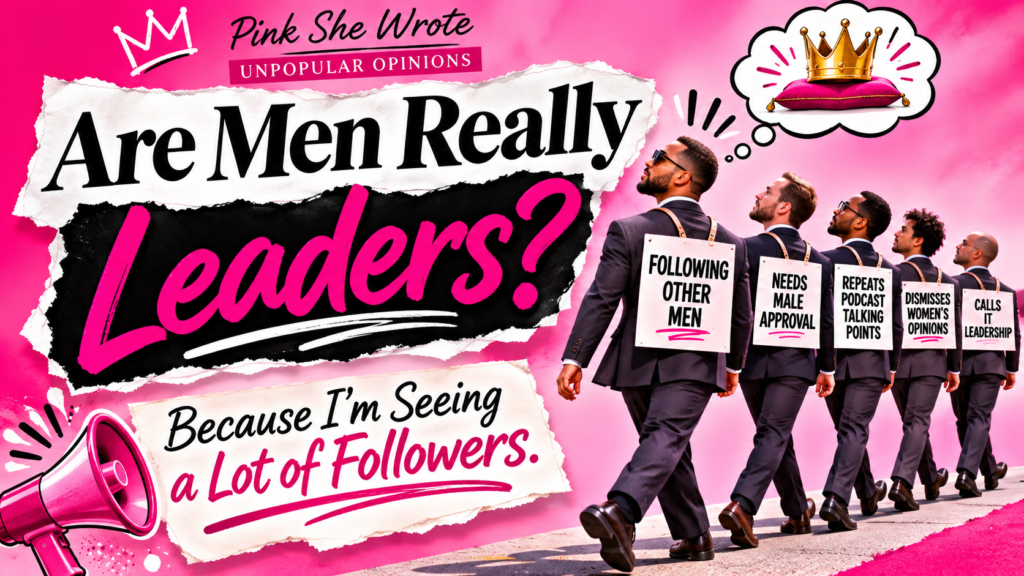
Men are natural-born leaders.
At least, that’s what society has been telling us for centuries.
Men are supposed to lead. Men are supposed to protect. Men are supposed to provide. Men are supposed to be the head of the household, the decision-makers, and the ultimate authority.
Okay. Cool.
But I have a question.
If men are supposedly natural-born leaders, why do so many of them behave like followers?
Because from what I’ve observed, some of the loudest self-proclaimed male leaders seem more concerned about earning approval from other men than actually demonstrating leadership.
And before somebody starts typing an emotional dissertation in my comment section, no, I’m not talking about every man walking this earth.
I’m talking about the men who proudly proclaim their superiority over women simply because they were born male, yet demonstrate very little independent thinking, accountability, emotional intelligence, or respect for women.
The same men who demand submission from women while following every unwritten rule established by other men.
The same men who dismiss women’s opinions but suddenly develop listening skills when another man speaks.
The same men who claim to be independent thinkers while repeating whatever their favorite male podcast host said last Tuesday.
And we’re supposed to call this leadership?
Baby, that’s a fan club.
Men Are So Male-Centered, It’s Almost Comical
Let’s talk about something I find particularly fascinating.
Some men are incredibly male-centered.
Now, when I say male-centered, I’m referring to men who measure their worth, masculinity, status, and accomplishments primarily through the approval of other men.
Think about it.
Women are constantly encouraged to center men.
We’re told to attract men, please men, respect men, support men, submit to men, and sometimes even sacrifice our ambitions for men.
But here’s the irony.
Some of the very men demanding that women center them are busy centering OTHER MEN.
Their masculinity is measured by what other men think.
Their success is measured by how they compare to other men.
Their relationships become opportunities to impress other men.
Their opinions? Sometimes they’re just recycled talking points from another man with a microphone and a podcast.
And don’t even get me started on the men who suddenly change their personalities when their male friends enter the room.
Sir, weren’t you just a completely different person five minutes ago?
Some men are so concerned about appearing masculine in front of other men that they’ll compromise their own personalities, interests, and values to fit in.
They’ll ridicule another man for enjoying something considered feminine.
They’ll mock men who express vulnerability.
They’ll question another man’s masculinity for treating women as equals.
All because they’re afraid of losing approval from the boys.
Some men don’t necessarily want women’s admiration. They want other men to admire them for having women.
Women become the audience, the accessories, and sometimes the trophies in a competition where the judges are other men.
And somehow, we’re supposed to believe this is leadership?
Interesting.
A Woman Says It, She’s Wrong. A Man Says It, He’s a Genius.
Now THIS is something that deserves an entire conversation.
Have you ever noticed how certain men will dismiss a woman’s opinion, only to take that exact same opinion seriously when another man says it?
A woman can present facts, explain her reasoning, provide examples, and practically deliver a PowerPoint presentation with references.
And what does she get?
“You’re being emotional.”
“You’re overthinking.”
“You don’t know what you’re talking about.”
“Calm down.”
But let another man repeat the same information.
Suddenly, it’s:
“Bro, you actually make a good point.”
OH, SO NOW WE HAVE LISTENING SKILLS?!
The issue was never necessarily the information.
Sometimes, the issue is that the information came from a woman.
And that’s what makes this behavior so disrespectful.
Women are expected to respect male authority, but our own intelligence, experiences, and perspectives aren’t always granted that same respect.
Why should a woman have to wait for a man to validate her words before they’re considered worthy of attention?
Why does a man’s disagreement become a debate, while a woman’s disagreement becomes an attitude problem?
And why are women so frequently expected to soften their language, manage their tone, and protect men’s egos just to be heard?
If you can respect another man’s opinion but automatically dismiss a woman’s, you’re not demonstrating leadership. You’re demonstrating bias.
And frankly, it’s exhausting.
The Patriarchy Has Men in a Chokehold, Too
Let’s discuss the elephant in the room.
Patriarchy.
A system of social expectations and power structures that has historically positioned men as authority figures and women as subordinate.
And while women have experienced its disadvantages for generations, there’s another side of this conversation that deserves attention.
Patriarchal expectations can also restrict men.
Some men grow up being told that crying makes them weak, vulnerability makes them feminine, and asking for help makes them less masculine.
They’re taught to compete with other men rather than develop healthy relationships with themselves.
They’re encouraged to dominate rather than cooperate.
And they’re sometimes conditioned to view anything associated with femininity as inferior.
Then society turns around and wonders why some men struggle with emotional vulnerability, healthy communication, and independent identity.
Well, look at the expectations they’ve been taught to follow.
And here’s where it gets particularly ironic.
Some men will passionately defend the very patriarchal expectations that prevent them from expressing themselves freely.
Imagine allowing another grown man to dictate what hobbies you enjoy, what emotions you’re allowed to express, and how you’re supposed to treat women.
And then calling yourself an independent thinker.
Baby, the math is not mathing.
Are You a Leader, or Do You Just Want Control?
One thing I’ve noticed about certain discussions surrounding traditional masculinity is how frequently leadership gets confused with control.
Some men insist that women should submit to them because men are naturally designed to lead.
But when you ask what qualifies them to lead, the answer often circles back to one thing.
“I’m a man.”
Okay?
And?
Being born male is not a leadership certification.
Leadership requires emotional intelligence, accountability, sound judgment, integrity, consistency, and the ability to consider perspectives beyond your own.
A genuine leader doesn’t need to constantly announce that he’s in charge.
He doesn’t need to intimidate people into respecting him.
He doesn’t need to silence women to feel powerful.
And he certainly doesn’t need to remind everyone that he’s the man every five business days.
If your authority disappears the moment someone questions you, perhaps you weren’t leading. Perhaps you were simply accustomed to obedience.
And there’s a difference.
Respect is not the same as submission.
Cooperation is not the same as control.
And disagreement is not disrespect.
If you cannot handle a woman having her own opinions, ambitions, boundaries, and independence, perhaps what you’re seeking isn’t a partnership.
Perhaps you’re seeking an audience that never questions the performance.
Why Are Some Men More Concerned About Other Men’s Approval Than Women’s Respect?
Now, this is where things become especially interesting.
Some men have absolutely no problem arguing with women, insulting women, dismissing women’s experiences, or publicly questioning women’s intelligence.
But when another man challenges them?
Suddenly, they’re choosing their words carefully.
Suddenly, they’re concerned about maintaining respect.
Suddenly, diplomacy has entered the chat.
Where was all this emotional regulation five minutes ago?
Consider the men who laugh along when their friends make degrading comments about women.
Or the men who witness another man behaving disrespectfully but refuse to challenge him because they don’t want to be labeled sensitive, weak, or a simp.
They might privately disagree.
They might even know the behavior is wrong.
But publicly?
Crickets.
Because standing up for a woman might cost them approval from the boys.
And apparently, that’s a price some aren’t willing to pay.
But here’s my question.
How can you claim to be a protector of women when you’re unwilling to challenge another man who disrespects them?
Protection shouldn’t mean controlling women, policing their clothing, or deciding where they’re allowed to go.
Sometimes, it simply means having enough integrity to speak up when someone is being mistreated.
Even when the person responsible is your friend.
Especially then.
The Manosphere: A Whole Lot of Followers Calling Themselves Alpha Males
Oh, we have GOT to discuss this.
Because the rise of the manosphere and certain masculinity-focused podcasts has introduced an interesting contradiction.
You have men preaching independence, dominance, and leadership while encouraging their audiences to adopt very specific ideas about how a man should behave.
How much money he should make.
What kind of woman he should date.
What women should wear.
How women should behave.
What makes a man masculine.
What makes a man weak.
And some listeners absorb these opinions as though they’ve been handed the Ten Commandments of Testosterone.
Now, there’s nothing inherently wrong with listening to podcasts, seeking mentorship, or learning from other men.
But there’s a difference between learning from someone and allowing someone else to do all your thinking.
If you’re constantly repeating another man’s opinions without examining them, questioning them, or considering alternative perspectives, how exactly are you demonstrating independence?
And don’t get me started on the obsession with calling yourself an alpha male.
Because if you have to announce your dominance every five minutes, who exactly are you trying to convince?
Women?
Other men?
Or yourself?
A confident man doesn’t need an entire internet community to reassure him that he’s masculine enough.
If Men Were Such Great Leaders, Why Couldn’t They See Women’s Potential?
Here’s another question I’ve been dying to ask.
If men are supposedly natural-born leaders, visionaries, and the brilliant architects of civilization, why did so many of them spend centuries limiting what women could contribute to society?
Seriously.
If leadership is about recognizing potential, encouraging innovation, and helping society progress, wouldn’t a great leader recognize the value of having women contribute beyond traditional gender roles?
Instead, women were historically denied opportunities for education, political participation, property ownership, financial independence, and professional advancement.
Why?
Because patriarchal societies largely decided that women’s primary purpose was to become wives, mothers, homemakers, and objects of male sexual desire.
And don’t get me wrong. There is absolutely nothing wrong with being a wife or mother. Those are meaningful roles for women who genuinely want them.
But being a woman should never mean those are your ONLY options.
And women certainly shouldn’t be reduced to sexual objects existing for men’s pleasure.
We’re human beings, not reproductive machines, unpaid domestic servants, or walking fantasies created to satisfy male desires.
We have minds.
We have ambitions.
We have talents.
We have dreams that don’t necessarily involve marriage, motherhood, or men at all.
And believe it or not, some women don’t want husbands or children.
SHOCKING, I KNOW.
Women are scientists, engineers, inventors, doctors, artists, entrepreneurs, philosophers, political thinkers, and leaders.
Women have contributed to society for centuries, even when their accomplishments were ignored, minimized, or credited to men.
Imagine how much further humanity might have progressed if women’s intelligence, creativity, and ambitions had been equally encouraged throughout history.
How many discoveries were delayed?
How many brilliant minds were never given the opportunity to flourish?
How many women spent their entire lives being told their greatest accomplishment would be becoming someone’s wife rather than being encouraged to discover what else they could become?
And here’s what makes this particularly ironic.
Some men claim they’re naturally better at leading society, yet the systems they defended historically prevented society from benefiting fully from women’s talents.
Baby, how is that visionary leadership?
That’s like running a company and deliberately refusing to utilize half your most talented employees because you believe their only purpose is to serve the other half.
And then wondering why your organization isn’t reaching its full potential.
MAKE IT MAKE SENSE.
A truly capable leader recognizes talent regardless of gender.
A truly confident man doesn’t feel threatened by a woman’s intelligence, independence, ambition, or success.
And a genuinely progressive society doesn’t reduce women to reproductive responsibilities, domestic labor, or sexual gratification.
Women are not merely supporting characters in men’s stories. We are individuals with our own stories, ambitions, identities, and contributions to make.
And perhaps that’s what bothers me most about patriarchal thinking.
For generations, women were told to recognize men’s potential while their own potential was treated as secondary.
We were expected to support men’s dreams while being encouraged to sacrifice ours.
We were told that men were destined to lead while women were destined to follow.
But if you’re such an exceptional leader, shouldn’t you be capable of recognizing greatness in someone other than yourself?
Especially when that someone is a woman?
Because a leader who can only recognize the value of people who resemble himself isn’t demonstrating vision. He’s demonstrating limitations.
And frankly, society has paid the price for those limitations long enough.
Some Men Want the Privileges of Leadership Without the Responsibilities
Let’s talk about accountability.
Because leadership sounds wonderful when it comes with authority, recognition, and the final say.
But what happens when leadership requires sacrifice?
What happens when it requires admitting you’re wrong?
Listening to someone you disagree with?
Taking responsibility for your mistakes?
Respecting boundaries that inconvenience you?
Supporting a woman whose accomplishments surpass your own?
Suddenly, some of these self-proclaimed leaders become remarkably uninterested in the job description.
They want respect without demonstrating respect.
They want loyalty without practicing loyalty.
They want authority without accountability.
They want a traditional woman without necessarily accepting the responsibilities they associate with being a traditional man.
And somehow, women are expected to applaud this arrangement.
Absolutely not.
If you want to lead, then demonstrate the qualities that make someone worth following.
And understand that not every woman wants or needs a man to lead her in the first place.
A healthy relationship can involve two capable adults making decisions together.
Imagine that.
Partnership.
Revolutionary concept, apparently.
Real Leadership Has Nothing to Do With Gender
Here’s what I want to make perfectly clear.
I don’t believe men are incapable of leadership.
There are wonderful men who demonstrate integrity, emotional maturity, compassion, accountability, and independent thinking.
Men who respect women without expecting a reward.
Men who challenge harmful behavior among their peers.
Men who don’t feel threatened by successful, intelligent, independent women.
Men who understand that masculinity doesn’t require domination.
And men who are perfectly comfortable being themselves without constantly seeking validation from other men.
Those qualities deserve recognition.
But those qualities aren’t exclusive to men.
Women demonstrate leadership every single day in families, workplaces, communities, relationships, and society.
And yet, women are still sometimes expected to prove their competence in spaces where men are automatically presumed capable.
That’s the double standard I question.
Leadership isn’t something you inherit through your gender. It’s something you demonstrate through your character.
A man who follows his principles rather than social pressure can be a leader.
A woman who challenges injustice can be a leader.
And a person who admits they don’t have all the answers can demonstrate more leadership than someone who insists they’re always right.
Because leadership isn’t about being the loudest person in the room.
It’s about having the integrity to do what’s right, even when nobody is applauding.
Final Thoughts: Who Are You Really Following?
So, are men really natural-born leaders?
I would argue that leadership isn’t natural to one gender any more than intelligence, compassion, or courage belongs exclusively to another.
And I find it fascinating that some of the men who insist most loudly on their supposed authority are also the ones who seem deeply invested in other men’s approval.
They’ll dismiss women’s opinions but eagerly seek validation from their male peers.
They’ll claim independence while following rigid expectations of masculinity.
They’ll demand respect while struggling to extend that same respect to women.
They’ll insist they’re leaders while allowing other men to determine how they should think, behave, and measure their worth.
And historically, male-dominated institutions have restricted women’s opportunities while insisting men were uniquely qualified to guide society.
Think about that contradiction.
How can you claim to be naturally gifted at leadership while failing to recognize the intelligence, capabilities, and contributions of half the population?
How can you call yourself independent when your masculinity depends on another man’s approval?
How can you demand respect from women while refusing to treat them as equals?
And how can you call yourself a protector when you’re more concerned about impressing your male friends than challenging their disrespectful behavior?
Because if your identity depends on impressing other men, if your confidence requires women to be beneath you, and if your principles disappear whenever your friends disagree with them, what exactly are you leading?
Or, better yet, who are you following?
Patriarchy has spent generations selling the idea that men are automatically entitled to leadership.
But having authority and being worthy of authority are two very different things.
And perhaps it’s time we stopped confusing masculinity with leadership altogether.
Because being a man doesn’t automatically make you a leader.
Just as being a woman doesn’t automatically make you a follower.
Leadership is a characteristic, not a chromosome.
And if your biggest concern is whether the boys approve of you?
Well, congratulations.
You might just be another follower wearing a leader’s costume.
And baby, the costume isn’t fooling everybody.
— Pink She Wrote 💋
Let’s Talk About It
Do you believe society confuses masculinity with leadership? Have you witnessed situations where a woman’s opinion was dismissed until a man repeated it? And do you think patriarchal expectations encourage some men to prioritize other men’s approval over women’s respect?
Share your thoughts in the comments. Let’s have a conversation.
Enjoyed this unapologetic perspective? Subscribe to The Pink List for more unfiltered opinions, personal reflections, and conversations that deserve to be had.
Because around here, we don’t just think pink. We think critically, too. 💗