Because your paycheck doesn’t come with a friendship contract.
When I started my career journey as a young professional in my 20s, I was a HUGE people pleaser.
I wanted my coworkers to like me. I wanted my managers to appreciate me. I wanted leadership to recognize me as someone who was kind, hardworking, dependable, and easy to get along with.
Basically, I wanted to be everybody’s favorite employee.
And baby, that was my first mistake.
I brought my feelings to work. I extended kindness, generosity, patience, and understanding to almost everyone I encountered. I believed that if I treated people well, worked hard, and remained professional, I would receive the same energy in return.
Oh, how adorable and naive I was.
Because somewhere between my early 20s and entering my 30s, I learned something about corporate America:
A lot of these people are fake as fuck.
Now, before somebody from Human Resources starts clutching their employee handbook, allow me to explain.
I’m not saying every coworker or manager is secretly plotting your downfall. Some people are genuinely wonderful, and I’ve had the pleasure of working alongside them.
However, I’ve also learned that workplace kindness, loyalty, and friendliness don’t always translate into genuine respect.
And sometimes, the people smiling in your face are the same ones making your work life unnecessarily difficult.
Corporate America Taught Me That Everybody Isn’t Your Friend
Throughout my career, I’ve experienced my fair share of workplace bullshit.
I’ve dealt with coworkers who snitched over the smallest things, passive-aggressive responses on Microsoft Teams and Slack (more like Slick, because some of those messages are shady as hell), and managers who somehow mastered the art of avoiding accountability.
I’ve been overlooked.
I’ve been underestimated.
I’ve been misunderstood.
I’ve been gaslit.
I’ve watched people refuse to take accountability for their mistakes while expecting everyone else to be responsible for theirs.
And the funniest part?
All I was trying to do was my damn job.
I wasn’t trying to become the CEO. I wasn’t campaigning for Employee of the Year. I wasn’t interested in joining some imaginary workplace popularity contest.
I simply wanted to be efficient, productive, and professional.
Yet somehow, even that can become a problem when you’re surrounded by people who mistake competence for competition, boundaries for attitude, and independence for being difficult.
That’s when I realized something.
I don’t need these people to like me. I need them to respect me.
There’s a difference.
I’m Here for a Paycheck, Not a Popularity Contest
Let me make something perfectly clear.
I don’t go to work to make friends.
I don’t go to work to find a husband.
I don’t go to work to become part of somebody’s corporate family.
I go to work because I have bills, responsibilities, personal goals, and a lifestyle that requires money.
That’s it. That’s the tweet.
My professional expectations are simple:
- Let me do my job.
- Provide the resources and information I need to do it correctly.
- Treat me fairly and professionally.
- Respect my time and boundaries.
- Pay me what we agreed upon.
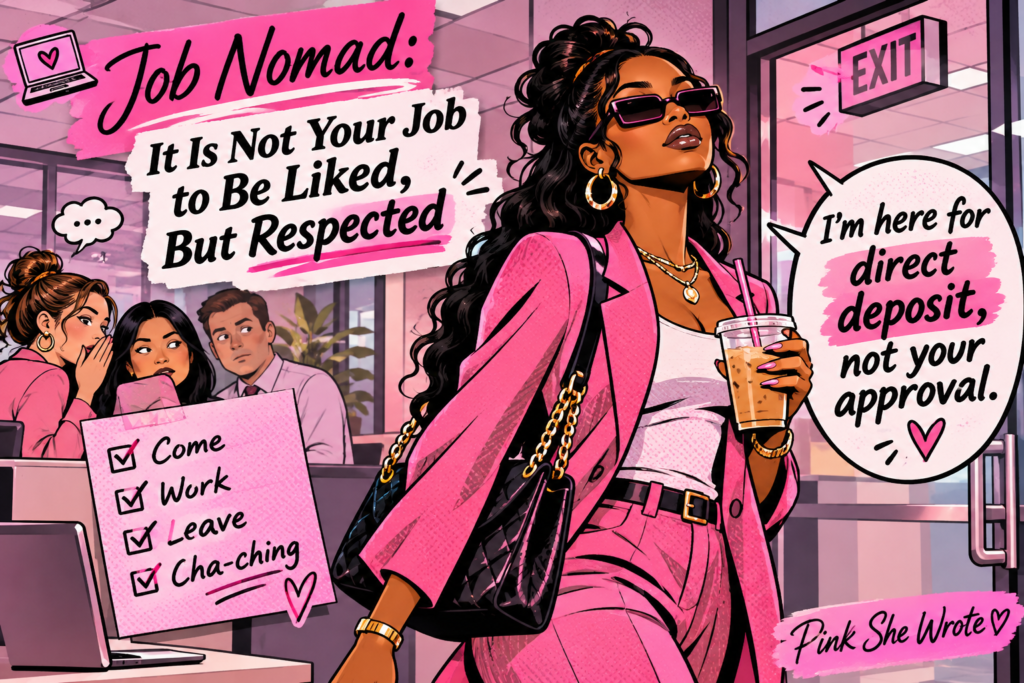
Come. Work. Leave. Cha-ching.
Now, does that mean I’m going to walk around the workplace with a permanent resting bitch face, refusing to speak to anybody?
Absolutely not.
I can be friendly. I can laugh with coworkers. I can participate in office celebrations, potlucks, holiday parties, and the occasional workplace gossip about how somebody stole Karen’s yogurt from the refrigerator.
But here’s where I draw the line.
Being friendly doesn’t mean we’re friends.
And being professional doesn’t mean I’m obligated to make myself personally available to everybody.
Your Coworkers Are Not Automatically Your Friends
Let’s talk about workplace friendships.
Can you develop genuine friendships at work?
Absolutely!
Some people meet lifelong friends through their careers, and I think that’s beautiful.
However, let’s not pretend that every workplace friendship is destined to survive outside the office.
Sometimes, your friendship exists because you share the same environment, the same frustrations, and the same mutual enemy: that damn job.
You laugh together.
You complain about the same ridiculous policies.
You exchange funny memes during your lunch break.
You discuss how you’re both one inconvenient email away from updating your résumés.
Then one of you quits.
Suddenly, those daily conversations become occasional messages. Those occasional messages turn into birthday reactions on Facebook. Eventually, you’re practically strangers.
And that’s okay.
Not every relationship is meant to exist outside the environment that brought you together.
Sometimes, your coworker was simply your emotional support colleague for that particular season of employment.
Misery loves company, and sometimes shared workplace misery is the only thing holding a friendship together.
That’s not necessarily a bad thing. It just means you should recognize the difference between genuine friendship and workplace companionship.
Enjoy your coworkers without automatically giving them unlimited access to your personal life.
And Please, Stop Looking for Love at the Office
Oh, and while we’re discussing workplace relationships, let’s address workplace romance.
Listen, I understand.
Sometimes you encounter an attractive coworker who makes those eight-hour shifts a little more tolerable.
Maybe they’re charming. Maybe they’re funny. Maybe they smell ridiculously good walking past your desk.
Have your little crush, honey.
Admire respectfully and keep it moving.
But personally?
I believe in not shitting where I eat.
Or, as I like to say, don’t seduce the hand that supplies you.
Because the last thing I want is to deal with relationship drama in the same place responsible for depositing my paycheck.
Imagine breaking up with somebody and still having to see their face during the Monday morning team meeting.
No, thank you.
And don’t even get me started on workplace romances involving managers and subordinates. Power imbalances, favoritism, conflicts of interest, and retaliation can turn an already complicated situation into a professional nightmare.
Of course, some workplace romances work out beautifully.
But as for me?
My direct deposit is the only workplace relationship I’m interested in maintaining.
What Does It Mean to Be Respected Instead of Liked?
Now, let’s get to the heart of this conversation.
When I say it’s not your job to be liked but respected, I’m not suggesting that you should become rude, arrogant, confrontational, or unpleasant.
Respect is not about making everybody afraid of you.
It’s about recognizing your value as an employee and refusing to accept mistreatment simply because you want people to approve of you.
Being liked is personal. Being respected is professional.
Being liked means someone enjoys your personality, finds you pleasant, or wants to spend time around you.
Being respected means your colleagues and leadership acknowledge your professional contributions, communicate appropriately, honor reasonable boundaries, and treat you fairly.
Your manager doesn’t have to invite you to their birthday party.
Your coworker doesn’t have to follow you on Instagram.
Your supervisor doesn’t have to consider you their favorite employee.
But they do need to communicate professionally, follow applicable workplace policies, and avoid discrimination, harassment, and retaliation.
And you owe them the same professional courtesy.
You can be the quietest employee in the office, keep your personal life private, decline social invitations, and still be an excellent employee.
Your professionalism should speak louder than your popularity.
Document the Bullshit and Protect Your Peace
One of the biggest lessons I’ve learned throughout my career is that you cannot control how people behave, but you can control how you respond.
If you’re dealing with a toxic coworker or manager, don’t waste your energy trying to win their approval.
Document the behavior.
Keep records of inappropriate communications, incidents, dates, times, and relevant witnesses when appropriate and permitted by company policy.
If someone is communicating unprofessionally through Microsoft Teams, Slack, or email, preserve the relevant information through approved channels.
If the situation involves possible discrimination, harassment, retaliation, or another policy violation, report it through the appropriate HR or compliance process.
And please understand that HR is not automatically your personal advocate. HR represents the organization and manages workplace concerns and risks. That doesn’t mean you shouldn’t report legitimate problems, but you should approach the process with documentation, realistic expectations, and an understanding of your rights.
Not every rude coworker is committing an HR violation, and not every unpleasant manager is breaking the law.
Sometimes people are simply assholes.
Unfortunately, being an asshole isn’t automatically illegal.
But that doesn’t mean you must tolerate repeated disrespect without establishing boundaries or exploring your options.
Let toxic coworkers and managers expose their own behavior while you protect your professionalism.
Don’t give somebody the satisfaction of provoking you into a reaction that could jeopardize your employment.
And if the workplace consistently refuses to address serious problems?
Start looking for your next opportunity.
Because sometimes the most powerful professional response isn’t an argument.
It’s an updated résumé and a better job offer.
Job Nomads Don’t Marry Their Jobs
If you’ve been following my Job Nomad series, you already know my philosophy.
I don’t believe employees should feel obligated to dedicate their entire lives to one employer.
A job is a professional agreement, not a marriage.
You provide your time, skills, experience, and labor.
The employer provides compensation and agreed-upon benefits.
That’s the arrangement.
And while you’re expected to fulfill your professional responsibilities, you’re not required to give a company unconditional emotional loyalty.
You don’t have to make your job your entire identity.
You don’t have to sacrifice your personal life to prove you’re dedicated.
You don’t have to remain somewhere that no longer aligns with your financial goals, professional interests, or personal well-being.
And you certainly don’t have to stay because your coworkers keep telling you, “But we’re like a family here!”
Girl, please.
Unless that corporate family is putting me in the will, let’s keep this relationship professional.
Being a Job Nomad means understanding that your career belongs to YOU.
Not your manager.
Not your coworkers.
Not the company.
You.
You have every right to pursue opportunities offering better compensation, stronger benefits, more flexibility, professional development, and a healthier work environment.
And when that opportunity arrives, you can respectfully submit your resignation, complete your responsibilities, and move forward.
No dramatic farewell speech required.
Stop Being the Employee Who Wants Everybody’s Approval
Looking back at my younger self, I realize how much unnecessary emotional energy I invested in wanting people at work to like me.
I took certain interactions personally.
I questioned myself when someone misunderstood my intentions.
I became frustrated when my kindness wasn’t reciprocated.
I wanted people to recognize that I was genuinely trying to be helpful.
But here’s what my 30s have taught me:
You can be kind without being a people pleaser.
You can be helpful without allowing people to take advantage of you.
You can be professional without becoming emotionally attached to your workplace.
You can accept constructive criticism without allowing somebody else’s opinion to define your worth.
And most importantly, you can be respected without being everybody’s favorite person.
There will always be someone who doesn’t like you.
Maybe they misunderstand your personality.
Maybe they feel intimidated by your competence.
Maybe your boundaries make them uncomfortable.
Or maybe the two of you simply don’t click.
Who cares?
As long as you’re fulfilling your responsibilities and treating people professionally, their personal approval is not a requirement for you to succeed.
Stop auditioning for acceptance in a workplace that’s supposed to compensate you for your labor.
Final Thoughts: Respect My Work, Respect My Boundaries, and Run Me My Check
At this stage in my career, I no longer have the desire to be everybody’s favorite coworker.
I want to do meaningful work, earn good money, have excellent benefits, maintain my peace, and enjoy my life outside of employment.
I don’t need a work bestie.
I don’t need a corporate family.
I don’t need a manager who treats me like their favorite child.
I need professionalism, fairness, reasonable expectations, and compensation that reflects my work.
And if I happen to meet wonderful people along the way, that’s a bonus.
But it is not the mission.
To my fellow Job Nomads, remember this:
Be kind, but don’t be a doormat.
Be professional, but don’t be a people pleaser.
Be dependable, but don’t make yourself endlessly available.
Be friendly, but understand that not everyone deserves personal access to you.
And when a better opportunity presents itself, don’t let workplace guilt keep you from pursuing it.
Because at the end of the day, you are building a career, not campaigning for Miss Congeniality of Corporate America.
Come. Work. Leave. Cha-ching. Repeat until better opportunities arrive.
And remember, darling:
It is not your job to be liked. It is your job to do your work professionally, and you deserve to be treated with respect while doing it.
XOXO,
Pink She Wrote 💋
Let’s Talk, Job Nomads!
Have you ever dealt with coworkers or managers who made you realize that being liked and being respected are two completely different things?
Do you believe in keeping workplace relationships strictly professional, or have you made genuine lifelong friends through your career?
Spill the corporate tea in the comments! And if you enjoyed this post, subscribe to The Pink List for more unapologetic conversations about careers, boundaries, personal growth, and navigating adulthood without losing yourself in the process.