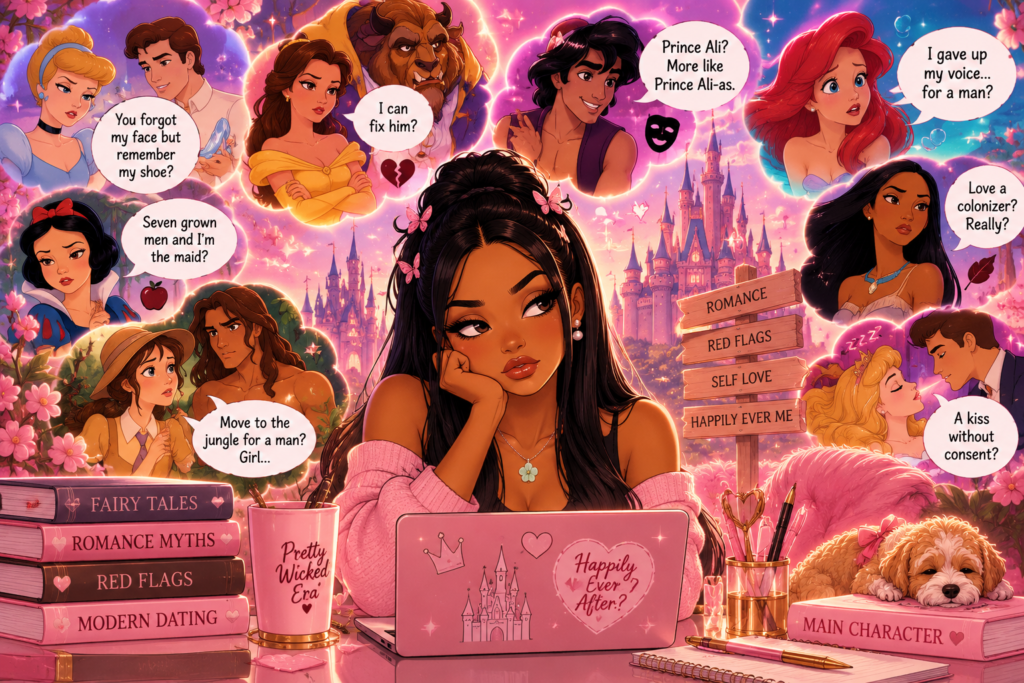
Red flags, romantic delusions, and the happily-ever-after myth.
Once upon a time, Disney had little girls believing that finding a handsome prince was the ultimate achievement in life.
And we ate that shit up.
The beautiful gowns. The magical castles. The talking animals. The handsome princes who magically appeared when a beautiful woman needed rescuing.
It was the ultimate romantic fantasy.
All you had to do was be beautiful, kind, patient, forgiving, and willing to sacrifice a few things along the way.
And eventually, some handsome man would sweep you off your feet and give you the ultimate reward:
Happily ever after.
Girl, please.
Now that I’m a grown woman with a better understanding of dating, relationships, and the importance of decentering men, I have some serious questions.
Because looking back at some of our favorite childhood movies, I can’t help but notice that quite a few of these so-called romantic love stories were filled with questionable decisions, unrealistic expectations, and enough red flags to decorate an entire kingdom.
And don’t even get me started on the emotional labor.
Now, before anyone gets their glass slipper in a twist, let me clarify something.
I still love Disney.
I love the nostalgia, the animation, the beautiful soundtracks, and the childhood memories. However, loving something doesn’t mean we can’t criticize it.
Disney didn’t invent society’s romantic expectations for women. Many of these fairy tales were created during periods when marriage, beauty, obedience, and domestic responsibilities were strongly associated with womanhood.
But when those messages are wrapped in catchy songs, beautiful animation, and charming princes, they can make questionable relationship dynamics look like the ultimate romantic fantasy.
So, let’s revisit some of these beloved Disney movies from the perspective of a grown woman who has learned that a handsome face doesn’t automatically make a man husband material.
And trust me, some of these princes have some explaining to do.
Cinderella: The Man Couldn’t Remember Her Damn Face
Let’s start with Cinderella.
A beautiful, kindhearted young woman who spends her days being mistreated by her stepmother and stepsisters while performing unpaid domestic labor.
Despite her circumstances, she remains patient, graceful, and kind.
Then, one magical evening, she attends a royal ball, meets a handsome prince, falls in love, and eventually escapes her miserable circumstances through marriage.
How romantic.
Except there’s one little detail that has bothered me for years.
HOW DID PRINCE CHARMING NOT REMEMBER HER FACE?
Sir.
You danced with this woman. You were fascinated by her. You were ready to find her after one evening together.
And the best idea you could come up with was to send someone throughout the kingdom with a glass slipper?
A SHOE?!
Not a description of her face. Not her voice. Not even a proper conversation to establish who she was.
A damn shoe.
And let’s not pretend Cinderella was the only woman in the kingdom who could potentially wear that shoe size.
Imagine going on a magical date with a man, only for him to forget what you look like and start asking every woman in Atlanta to try on your heels.
Absolutely not.
But jokes aside, Cinderella’s story also reinforces a romantic fantasy that many women were raised to believe.
That if you’re beautiful enough, kind enough, and patient enough, a man will eventually come along and change your life.
Now, Cinderella deserved to escape her abusive household. But why was marriage to a wealthy prince presented as the solution to all her problems?
The dating lesson: A man should not be your escape plan, financial security plan, or entire reason for happiness. Build a life you love so that love becomes an addition, not your only way out.
Beauty and the Beast: You Are Not His Rehabilitation Center
Belle was intelligent, independent, and loved reading.
She had dreams beyond her little village and wasn’t interested in marrying Gaston, despite everyone treating him like the most eligible bachelor around.
And honestly?
Good for her.
Gaston was arrogant, entitled, controlling, and couldn’t understand why a woman wouldn’t want him.
A walking red flag.
But somehow, Belle managed to avoid one problematic man only to find herself living with another.
Enter the Beast.
This man imprisoned her father, held Belle captive in his castle, had serious anger management issues, and frequently intimidated the people around him.
And we’re supposed to call this romantic?
Sir, you need therapy, not a girlfriend.
Now, I understand the movie is about looking beyond appearances and recognizing someone’s capacity for change.
And yes, the Beast eventually begins to change his behavior.
But let’s discuss how often women are encouraged to overlook a man’s present behavior because they believe in his potential.
He’s a good man deep down.
He’s just misunderstood.
He had a difficult childhood.
He’ll change once he realizes how much I love him.
Sound familiar?
Women are sometimes expected to become therapists, mothers, emotional support systems, and personal rehabilitation centers for grown men who refuse to take responsibility for themselves.
And the worst part?
Some women spend years loving the potential of a man instead of accepting the reality of who he is.
Ladies, I’m going to say something that might hurt.
Potential does not pay the emotional bills.
A man can have all the potential in the world, but if his actions consistently show disrespect, aggression, or emotional immaturity, that potential means absolutely nothing.
The dating lesson: Stop dating potential. You can support someone’s personal growth without becoming responsible for fixing them.
Aladdin: A Handsome Catfish Is Still a Catfish
Now listen.
Aladdin was fine.
I’ll give him that.
But let’s be serious.
This man was a scrub with a magical networking opportunity.
He knew Jasmine was royalty, and rather than approaching her honestly, he decided to create an entirely different identity.
Fake wealth.
Fake social status.
Fake royal title.
A whole fake lifestyle.
And thanks to Genie, this man pulled off one of the most elaborate catfishing operations in Disney history.
Prince Ali?
More like Prince Ali-as.
And doesn’t this sound familiar in modern dating?
Men exaggerating their income, job titles, lifestyles, and intentions because they’re afraid that being themselves won’t be enough to impress a woman.
Some pretend to want relationships when they’re only interested in sex.
Some pretend to be emotionally available.
Some pretend to have their lives together.
Others build entire personalities around what they believe a particular woman wants.
Then, once she’s emotionally invested, the mask begins to fall.
Now, Aladdin’s insecurity about his social status was understandable. But insecurity doesn’t excuse deception.
Of course, Jasmine eventually forgives him.
And forgiveness can certainly be a healthy choice when someone demonstrates genuine accountability.
But there’s something interesting about how frequently female characters are expected to understand and forgive a man’s lies because he supposedly meant well.
The dating lesson: A man who genuinely wants you should feel comfortable showing you who he is. If he needs to fabricate his identity to get your attention, that’s not romance. That’s deception with background music.
Tarzan: Jane, Girl, What Are We Doing?
Now, Tarzan isn’t technically part of Disney’s official princess lineup, but Jane deserves an honorable mention because I have questions.
Jane was an intelligent, educated woman who traveled to the jungle with her father to study gorillas.
She was adventurous, curious, and had an entire life outside the wilderness.
And then she met Tarzan.
A handsome, muscular man raised by gorillas who was still learning how human society worked.
And somehow, this woman decided to leave her familiar world behind to live in the jungle.
Ma’am.
What about healthcare?
Sanitation?
Mosquitoes?
Parasites?
And don’t even get me started on potential infections and diseases.
Love is wonderful, but I personally need access to indoor plumbing.
Now, to be fair, Tarzan was kindhearted, protective, curious, and willing to learn. He wasn’t necessarily a toxic man.
But Jane’s decision raises an interesting conversation about how much women are willing to sacrifice for love.
How many women have moved across the country for a man?
Abandoned career opportunities?
Distanced themselves from friends or family?
Completely changed their lifestyles because they believed love required it?
Now, there’s nothing inherently wrong with relocating or making sacrifices for a partner.
But those decisions should be mutual, thoughtful, and aligned with your goals.
The dating lesson: Love may require compromise, but don’t abandon everything you’ve worked for simply because a man makes your heart flutter.
Especially if that man lives in a tree.
Snow White: Seven Grown Men and Not One Housekeeper?
Snow White’s story is another interesting one.
First, we have the Evil Queen, a woman so obsessed with being the most beautiful person in the kingdom that she wants Snow White dead.
Imagine being so threatened by another woman’s beauty that you make it your entire villain origin story.
And right there, we’re introduced to another questionable message.
A woman’s beauty is her greatest asset, and other beautiful women are competition.
Then Snow White escapes into the forest and finds herself living with seven dwarfs.
Seven grown men.
With an entire house.
And what does Snow White do?
She cleans their home.
Cooks their meals.
Organizes their household.
And teaches these men how to wash their damn hands.
SEVEN MEN.
Girl, you didn’t find a safe house. You found an unpaid internship in domestic labor.
Now, to be fair, the dwarfs offered Snow White shelter and protection.
But it’s still hilarious how quickly she became responsible for managing their home.
Then comes the ending.
Snow White eats a poisoned apple, falls into an enchanted sleep, and is eventually awakened by a prince’s kiss in Disney’s version.
A prince she barely knows.
A prince kissing an unconscious woman.
And somehow, this is presented as the ultimate romantic rescue.
Excuse me?
Imagine waking up to some random man kissing you because he thought you were beautiful.
Sir, who are you?!
Of course, this is a magical fairy tale, not a realistic dating scenario. But it’s worth examining how stories have historically romanticized male pursuit and access to women without much consideration for consent.
The dating lesson: Being beautiful, nurturing, and caring doesn’t mean you owe anyone domestic labor, romantic affection, or access to your body.
Sleeping Beauty: One Date and Suddenly It’s True Love?
Aurora is another Disney princess whose love story moved at lightning speed.
This woman meets Prince Phillip in the woods.
They sing.
They dance.
They exchange a few romantic glances.
And suddenly, we’re supposed to believe they’ve found true love.
Girl, you don’t even know his last name.
Okay, technically, they were already betrothed through their royal families, although they didn’t realize each other’s identities when they met.
But still.
One meeting?
No real discussion about values?
Compatibility?
Future goals?
Whether he wants children?
Financial responsibilities?
Nothing?
Just singing in the forest and hoping for the best?
That’s not relationship development. That’s a musical speed date.
Then there’s the famous kiss.
Aurora is unconscious under a magical sleeping curse, and Phillip kisses her to break it.
Within Disney’s fairy-tale world, it’s supposed to be a heroic act of love.
But when viewed through modern expectations of consent, the imagery becomes considerably more uncomfortable.
And here’s something else worth mentioning.
Older literary stories associated with the Sleeping Beauty tradition are much darker than Disney’s adaptation.
In Giambattista Basile’s Sun, Moon, and Talia, a sleeping woman is sexually assaulted by a king. It’s a different version of the sleeping-maiden story, not the same plot as Disney’s film.
So, yes, fairy-tale history gets disturbing.
The dating lesson: Attraction is not the same as compatibility, and romantic interest does not cancel out the importance of consent.
The Little Mermaid: Losing Your Voice for a Man Is Not Romantic
Ariel was sixteen years old.
SIXTEEN.
A teenager who dreamed about exploring the human world, collecting human objects, and experiencing life beyond the ocean.
And then she saw Prince Eric.
Now, let’s give Ariel some credit. Her fascination with humans existed before she met Eric.
But once she developed feelings for him, things escalated rather quickly.
She made a deal with Ursula.
Gave up her voice.
Left behind her underwater home.
And became human.
All while hoping to win the prince’s love.
Girl.
YOUR VOICE?!
Of all the things you could sacrifice, you chose the one thing that allows you to express yourself?
The symbolism alone is enough to make me scream.
How many women have made themselves smaller for a man?
How many have stopped expressing their opinions because their boyfriends didn’t like outspoken women?
How many have abandoned their hobbies, personal styles, friendships, or ambitions because they wanted to become the ideal girlfriend?
And how many have tolerated disrespect because they were terrified of losing the relationship?
That is what makes Ariel’s story so interesting to revisit.
She wanted freedom, adventure, and independence, yet her romance became deeply intertwined with the sacrifices she made.
And while Disney never firmly establishes Eric’s age in the original animated movie, I still find it questionable how heavily a sixteen-year-old character’s story revolves around securing romantic love.
The dating lesson: Never silence yourself to make a man comfortable. A healthy relationship should allow you to maintain your identity, boundaries, and independence.
Pocahontas: Disney Really Romanticized Colonialism?
Now, Disney.
What the hell were we doing here?
Because of all the love stories you could have created, you decided to take the history of a real Indigenous woman and transform it into a romance involving an English colonizer?
Let’s discuss.
In Disney’s version, Pocahontas falls in love with John Smith, an English settler who arrives in Virginia alongside colonists seeking land and resources.
And somehow, we’re supposed to focus on the beautiful romance between two people from different worlds.
But there’s one enormous problem.
COLONIALISM.
The real Pocahontas was not the adult romantic heroine depicted in the animated movie.
She was a young Indigenous girl, approximately ten to twelve years old when the English established Jamestown in 1607.
There is no reliable historical evidence that she and John Smith shared the romantic relationship Disney portrayed.
Her real life was shaped by conflict, displacement, captivity, and the power imbalance between Indigenous communities and English colonists.
But Disney gave us a love story.
Now, I understand that the movie attempted to communicate messages about tolerance, cultural understanding, and prejudice.
But turning colonial history into romantic entertainment can obscure the violence and suffering experienced by Indigenous communities.
And while I love the music, especially Colors of the Wind, I cannot overlook how much history was rewritten to create a marketable romance.
The dating lesson: Love does not magically erase differences in power, historical injustice, or harmful behavior. Respect requires more than romantic attraction.
So, Did Disney Actually Brainwash Us?
Now, here’s where I want to make something clear.
I’m not arguing that Disney movies automatically cause women to have unhealthy relationships.
That would be an exaggeration.
However, the media we consume, especially during childhood, can contribute to the ideas we develop about gender, beauty, romance, and social expectations.
And Disney princess movies were certainly influential pieces of popular culture.
Think about some of the recurring themes in the older films.
Women were rewarded for beauty, patience, kindness, self-sacrifice, and devotion.
Men were frequently positioned as rescuers, protectors, romantic rewards, or the solution to a woman’s unfortunate circumstances.
Meanwhile, marriage was often presented as the final destination.
And they lived happily ever after.
But what happens after that?
What happens when Prince Charming turns out to have poor communication skills?
What happens when the Beast doesn’t change?
What happens when Prince Ali’s entire lifestyle was fabricated?
What happens when the relationship requires a woman to sacrifice everything while her partner sacrifices almost nothing?
These are the questions fairy tales rarely explore.
And although fictional stories don’t have to depict healthy relationships perfectly, it’s important that we learn how to separate romantic fantasy from real-world expectations.
Because love alone does not make a relationship healthy.
Love without respect is not enough.
Love without trust is not enough.
Love without accountability is not enough.
And love certainly doesn’t require a woman to abandon herself.
Thankfully, Disney Princesses Have Evolved
One thing I appreciate about newer Disney films is that their female characters have become more complex.
We have Tiana, who dreams of opening her own restaurant and works tirelessly toward financial independence.
Mulan, who challenges gender expectations and demonstrates courage, intelligence, and determination.
Merida, who refuses to accept the idea that marriage should determine her future.
Moana, whose story focuses on leadership, family, identity, and discovering her purpose.
And Elsa, whose greatest struggles revolve around self-acceptance, family, and responsibility rather than winning a man’s affection.
These characters remind us that a woman’s story can revolve around so much more than romantic relationships.
She can have ambitions.
She can be independent.
She can pursue an education, career, or business.
She can travel.
She can experience adventure.
She can choose to remain single.
She can decide marriage and motherhood aren’t part of her story.
And most importantly?
She can live happily ever after without a man.
Now, that doesn’t mean romantic love is bad or that women who desire marriage are somehow less independent.
Absolutely not.
I believe women should have the freedom to choose the lives they genuinely want.
But I also believe we’ve spent far too much time teaching girls how to become desirable to men instead of teaching them how to recognize what they deserve in a relationship.
And there’s a difference.
The Real Happily Ever After Is Choosing Yourself
At the end of the day, I don’t regret growing up with Disney princess movies.
They gave me beautiful memories, imaginative adventures, iconic music, and characters I still adore.
But I also recognize that some of those romantic fantasies don’t translate particularly well into adulthood.
Because here’s what I’ve learned.
You don’t need a prince to rescue you.
You don’t need to fix a damaged man.
You don’t need to sacrifice your voice to be loved.
You don’t need to forgive dishonesty simply because someone claims they had good intentions.
And you certainly don’t need to measure your worth by whether a man decides you’re worthy of becoming his wife.
You are already the main character of your own story.
Your goals matter.
Your independence matters.
Your happiness matters.
And your happily ever after doesn’t have to include a wedding, a castle, or a handsome prince.
If love comes along and adds something beautiful to your life, wonderful.
But if it doesn’t?
You still have an entire life worth living.
So, dear Disney, thank you for the memories.
But some of those romantic lessons?
We’re leaving them in the fairy-tale books where they belong.
And for my next post, I’m giving Disney men a chance to redeem themselves because, believe it or not, a few of them might actually qualify as green flags.
Yes, ladies.
They exist.
Stay tuned.
Stay unapologetic. 💗
Disclaimer: This article is a humorous, opinionated critique of fictional Disney relationships and their cultural messages. It is not intended to claim that Disney movies alone determine dating behavior or that every fictional character should be judged by real-world standards. The purpose is to encourage critical thinking about romance, gender expectations, consent, and relationship dynamics.
Now, I want to hear from you: Which Disney prince or love story gives you the biggest red flag today? And which one do you still secretly love?
Let's talk.
[…] you read my previous article, Disney Princesses Lied to Us About Love (And We Fell for That Shit), you already know I have some serious opinions about the romantic lessons Disney taught us growing […]